
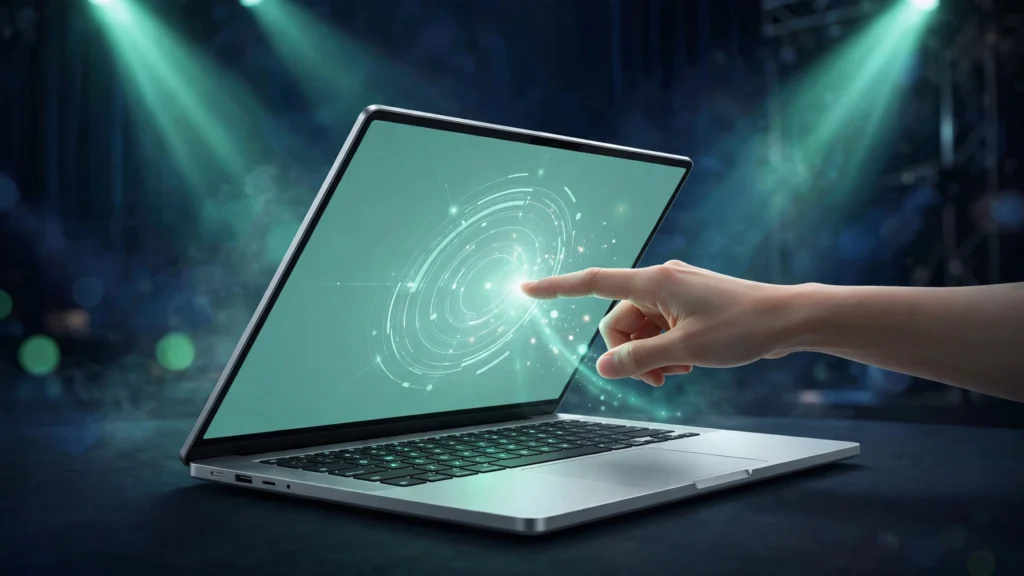
Apple “Pro and Tell” Event (October 28): Touchscreen MacBook Pro, OLED Displays and Everything to Expect
Apple just confirmed its second hardware event of the month — and this one could bring the biggest change to the Mac in over a decade. The Apple Pro and Tell event takes place on Wednesday, October 28, 2026, in Los Angeles, and all signs point to Apple’s first-ever touchscreen MacBook Pro headlining the show.
Here’s everything that’s confirmed, everything that’s credibly rumored, and what it all means if you’re thinking about buying a Mac.
When and Where Is the Apple Pro and Tell Event?
Apple marketing chief Greg Joswiak confirmed the event on X, writing “Can’t wait to pro and tell next week” alongside an animated invite showing the Apple logo forming from flowing, multi-colored light trails. The details:
- Date: Wednesday, October 28, 2026
- Time: 10:00 AM Pacific — 1:00 PM Eastern, 5:00 PM UK, 8:00 PM Riyadh
- Location: Los Angeles, in-person “Apple Experience”
- Format: Hands-on media event, not a streamed keynote
That last point matters. Like the October 13 “Welcome home” launch in New York — which introduced the HomeView smart display, HomePod mini 2, and a new Apple TV 4K — this is being billed as an “Apple Experience”: expect a series of press releases on Apple.com, a product video or two, and hands-on time for invited media and creators (YouTuber Marques Brownlee posted his invitation), rather than a traditional keynote livestream.
Headliner: The First Touchscreen MacBook Pro
The name says it all. “Pro and tell” is widely read as a wink toward the headline product: Apple’s first Mac with a touchscreen, ending a design philosophy the company has defended for more than a decade. Steve Jobs famously called touchscreen laptops “ergonomically terrible” — but the market, and Apple’s own iPad Pro, have moved on.
According to Bloomberg’s Mark Gurman, the redesigned 14-inch and 16-inch MacBook Pro models will feature:
- OLED touchscreens — tandem OLED displays, a huge leap from the current mini-LED panels, with deeper blacks and better contrast
- Direct touch input — the first time you can tap, swipe, and pinch directly on a Mac display
- Dynamic Island-style cutout — replacing the notch with the iPhone’s pill-shaped interface element
- Significantly lighter enclosures — a new, slimmer design
- M5 Pro and M5 Max chips — notably, the high-end models are expected to skip straight to the M5 Pro/Max generation rather than waiting for M6 Pro/Max
This is the product to watch. A touchscreen fundamentally changes how macOS apps are designed, how accessories work, and how Apple positions the Mac against the iPad. If the rumors hold, it’s the most consequential Mac redesign in years.
Curious what the OLED fuss is about? Our OLED vs QLED vs Mini-LED breakdown explains exactly why OLED’s per-pixel lighting delivers the contrast jump everyone keeps talking about.
M6 Macs: Entry-Level MacBook Pro and iMac
Not everyone needs (or wants to pay for) a touchscreen. Apple is also expected to refresh the more conventional end of the lineup with its newest silicon:
- Entry-level 14-inch MacBook Pro with M6 chip — same non-touchscreen design as the current model, but with Apple’s latest silicon inside
- M6 iMac — replacing the current M4 iMac, again keeping the existing design
These are the sensible upgrades: same beloved designs, faster chips, likely similar pricing. If you buy a Mac for work rather than wow factor, the M6 models are probably your lane.
OLED iPad Mini
The iPad mini is reportedly getting its biggest refresh in years:
- OLED display — finally bringing the mini in line with the iPad Pro’s screen quality
- Relocated FaceTime camera — moved to the landscape edge, matching the rest of the iPad lineup
- Revamped speaker system — addressing one of the mini’s long-standing weak points
The iPad mini has always been the sleeper pick of the iPad family — the perfect size for reading, travel, and one-handed use. An OLED screen makes it a much easier recommendation.
When Can You Buy Them?
Bloomberg reports that Apple retail stores are preparing to begin selling the new products on Friday, November 6 — just over a week after the event. That tight turnaround is typical of Apple’s “Experience” format events: announce, demo to press, and ship fast.
One caution from Macworld’s reporting: the high-end touchscreen models could be priced even higher than the current non-touchscreen M5 Pro and M5 Max MacBook Pros. A touchscreen OLED redesign plus new chips is not a recipe for discounts.
Should You Wait to Buy a Mac?
If you’re shopping for a MacBook Pro right now, the answer is almost certainly yes — wait nine days. Here’s the decision tree:
- Want the latest and greatest? Wait for the touchscreen models on October 28. Even if you decide touch isn’t for you, current models will likely see price cuts.
- Need a Mac for work on a budget? Wait for the M6 entry-level 14-inch — newest chip, presumably similar price to today’s model.
- Eyeing an iMac? Definitely wait. The M4 iMac is about to be replaced.
- Want an iPad mini? Wait. The OLED upgrade is the first meaningful screen improvement in the mini’s history.
- Need something TODAY? Then buy today — but know that better options land in nine days.
Apple’s Busy October
Step back and it’s been a remarkable month for Apple. The October 13 “Welcome home” event in New York launched the company’s smart-home push — including the $299 HomeView smart home hub we covered in detail — plus the HomePod mini 2 and a new Apple TV 4K. Now, two weeks later, the Mac gets its turn.
Between the foldable iPhone Duo’s sellout pre-orders, the HomeView launch, and now a touchscreen MacBook Pro, Apple is having one of its busiest product quarters in recent memory. The “Pro and tell” event is the exclamation point.
Why Apple Resisted Touchscreens for So Long
To understand why a touchscreen Mac is such a big deal, rewind a decade. Apple’s position — articulated most famously by Steve Jobs, who called touchscreen laptops “ergonomically terrible” — was that touch belongs on direct-manipulation devices (iPhone, iPad) while the Mac is a precision tool for keyboard, trackpad, and mouse. Touchscreens on laptops, Apple argued, meant gorilla-arm fatigue and smeared displays.
Three things changed. First, the iPad Pro blurred the line — with keyboard accessories and trackpad support, it became a laptop replacement for millions, proving people want touch and a keyboard in one device. Second, Windows laptops normalized touch — an entire generation of users now expects to tap their laptop screen, and Macs look increasingly odd without it. Third, Apple’s own silicon — the M-series chips already power both Macs and iPads, so the technical gap between the platforms has effectively vanished.
The touchscreen MacBook Pro isn’t Apple admitting it was wrong. It’s Apple deciding the market — and its own chip architecture — finally made the old distinction obsolete.
What About the Rest of the Mac Lineup?
Conspicuously absent from the rumors: the MacBook Air, the Mac Studio, and the Mac Pro. The Air was refreshed relatively recently and typically follows the Pro’s lead by a generation, so an OLED touchscreen Air is likely a 2027 story at the earliest. The desktop Macs march to their own slower cadence.
This is a deliberate strategy. Apple is using the high-end MacBook Pro — its most visible, most aspirational laptop — to prove the touchscreen concept. If professionals embrace it, the technology trickles down. If they don’t, Apple has contained the experiment to the product line best able to absorb the risk.
Apple Pro and Tell Event FAQ
Is the touchscreen MacBook Pro confirmed? No — Apple has only confirmed the event itself. The touchscreen MacBook Pro, OLED displays, and chip details all come from Bloomberg’s reporting and corroborating outlets. Treat them as highly credible rumors, not announcements.
Will there be a livestream? Probably not a traditional keynote. Apple’s recent “Experience” events have meant press releases plus product videos on Apple.com, with hands-on coverage from invited media. Expect the news to break around 10:00 AM PT / 8:00 PM Riyadh.
Will the touchscreen MacBook Pro cost more? Almost certainly. Macworld’s reporting suggests the redesigned models could be priced above the current M5 Pro/Max MacBook Pros. New display technology plus a redesign rarely comes cheap.
Should I buy the current MacBook Pro now? Only if you need one this week. In nine days you’ll either get a dramatically better machine or a discounted current-generation model. Patience is the winning move.
The Bottom Line
The Apple Pro and Tell event on October 28 is shaping up to be the most consequential Mac showcase in years. A touchscreen MacBook Pro with OLED would break a decade of Apple design dogma; M6 Macs and an OLED iPad mini round out a stacked lineup; and with retail availability reportedly starting November 6, you won’t wait long to buy. Mark your calendar for 8:00 PM Riyadh time on October 28 — and if you’re Mac shopping, whatever you do, don’t buy before then.
Whether you tune in live or catch up later, the Apple Pro and Tell event could redefine the Mac for the next decade. Bookmark Apple’s official events page for the press releases and product videos when the Apple Pro and Tell event kicks off at 8:00 PM Riyadh on October 28 — and check back here after the Apple Pro and Tell event wraps, because the Apple Pro and Tell event announcements will shape our Mac buying guides for months to come.