
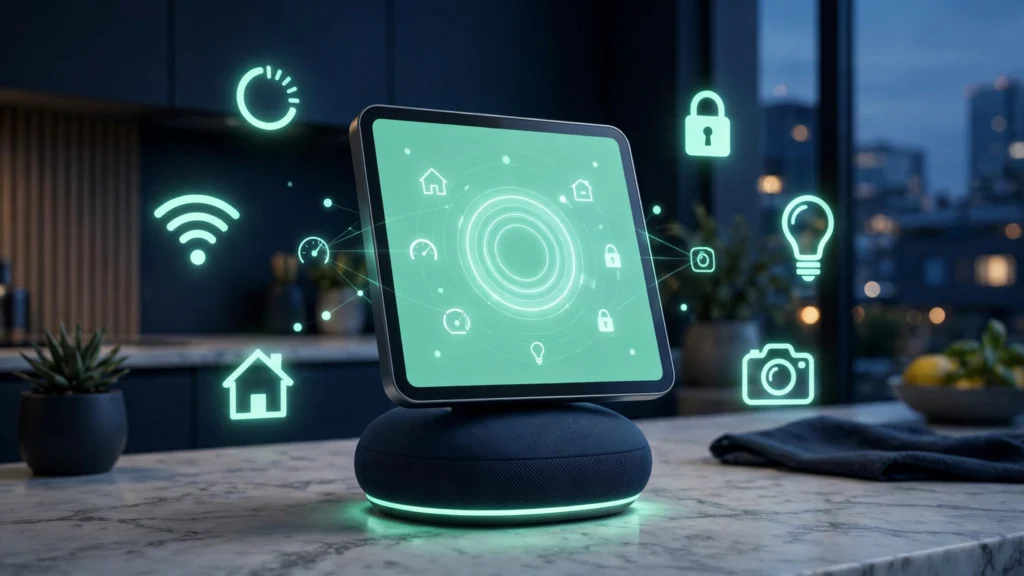
Apple HomeView: Everything We Know About Apple’s $299 Smart Home Hub
Apple HomeView is finally real. Announced on October 13, 2026 at Apple’s “Welcome Home” event, the $299 smart home hub is Apple’s first serious attempt to own the center of your house — and it arrives with a redesigned Siri AI, facial recognition, and a wall-mounted twin. Pre-orders are already open, with shipments beginning November 13, 2026. Here’s everything we know about Apple’s smart home play, from specs and pricing to the one major market it won’t be sold in.
What Is Apple HomeView?
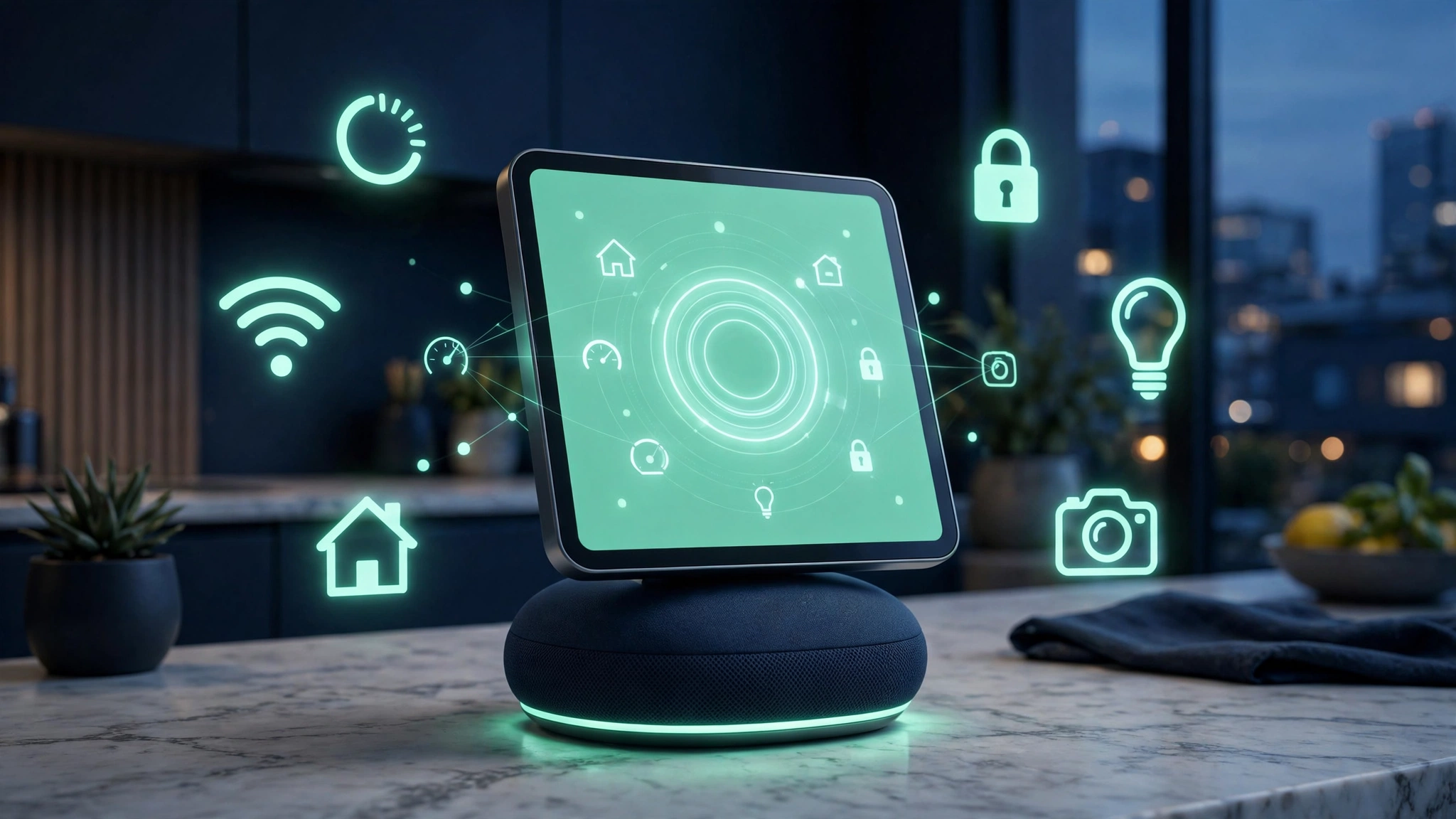
Apple HomeView is Apple’s answer to the Amazon Echo Show and Google Nest Hub — but built around privacy and Apple’s ecosystem rather than a shopping cart or a search bar. It’s a dedicated smart home display that plays music and video, makes FaceTime calls, controls HomeKit accessories like lights, locks, thermostats, and blinds, and serves as the voice of the new Siri AI in your home.
Two versions are launching at the same $299 price:
- Tabletop model: a 7-inch display on a domed aluminum speaker base, connected by a stainless steel hinge that lets you tilt the screen to your ideal angle. It ships in silver, starlight, rose pink, and space gray, with matching USB-C cable and power adapter in the box.
- Wall-mounted model: the same display without the speaker base, in silver and space gray. The mount is sold separately through Schneider Home, starting at $59.95 for a USB-C wall connector — AC wired and PoE options cost more.
The tabletop version gets richer sound thanks to a down-firing woofer and dual force-cancelling passive radiators in its base, plus two full-range drivers with Spatial Audio and computational audio that tunes itself to the room. The wall model keeps two custom drivers with computational audio tuned for on-wall placement.
Apple HomeView: Full Specifications
Apple’s published spec sheet puts Apple HomeView firmly in premium territory for a smart display:
- Display: 7-inch square Liquid Retina, 1088 x 1088 resolution, 220ppi, True Tone, oleophobic coating. Brightness ranges from a bedside-friendly 0.3 nits to 500 nits in sunny rooms.
- Chip: A18 with Secure Enclave for on-device audio and video processing.
- Camera: 12MP ultra-wide (f/2.4) with Center Stage, which follows you around the frame during FaceTime calls.
- Microphones: four far-field beamforming mics that can even recognize the sound of smoke and carbon monoxide alarms and alert you.
- Connectivity: Wi-Fi 6 (802.11ax) with MIMO, Bluetooth 6.0, and Thread for smart home devices.
- Facial recognition: identifies up to six household members for personalized home screens.
Siri AI: The Real Story
The hardware is nice, but the headline is Siri AI — the rebuilt, Apple Intelligence-powered assistant that Apple marketing chief Greg Joswiak described as being “at the core” of the device. Siri AI is conversational, can take actions across apps, and surfaces proactive information from Messages, Calendar, Apple Music playlists, and more. You can even customize the expressiveness and pace of Siri’s voice from your paired iPhone or iPad.
It’s an interesting moment for AI assistants generally — OpenAI is simultaneously testing visual ads inside ChatGPT, which shows just how aggressively the AI race is pushing into every screen we own. Apple is betting its differentiator is trust: camera and microphone processing happens locally on the A18’s Secure Enclave, and your Messages and Calendar content only appears when HomeView recognizes your face and your paired, recently-unlocked iPhone or iPad is nearby. Guests get shared albums and music; your texts stay yours.
One caveat: Siri AI is currently in beta and limited to English, so the conversational magic may vary by region and language support.
Faces, Distance-Aware UI, and the Sous-Chef Trick
Apple borrowed the watch-face concept from the Apple Watch. Apple HomeView’s interface is built around customizable “faces” navigated by swipe gestures: a Photos face, a “Flow” face that responds to movement, a Snoopy face that reacts to the time of day and weather, a Home Modular face for instant smart-home control, and a Home Camera face that can livestream up to nine camera feeds at once. Widgets for weather, calendar, and more echo the iPhone’s StandBy Mode.
Cleverly, the interface adjusts to your distance — large, glanceable information from across the room, richer detail as you step closer. And in a genuinely delightful detail, Apple calls HomeView “the perfect sous chef”: it can convert a recipe from the web into step-by-step instructions with hands-free timers and ingredient tracking. For a kitchen counter device, that’s the killer feature hiding in the fine print.
On apps, you get Apple’s core set — FaceTime, Music, Podcasts, TV, News, Messages — plus select third-party audio and video apps. Intercom lets you broadcast a message to the whole household, and Siri AI conversations sync across your Apple devices.
Price, Release Date, and Where You Can Buy It
The headline number is simple: $299 for either model. Pre-orders opened on announcement day in the US, UK, Canada, Australia, India, and New Zealand, with Singapore following on October 15. Devices ship November 13, 2026.
Budget carefully, though — the wall-mounted version’s mount is an extra cost ($59.95–$129.95 depending on the wiring option), which pushes the true cost of the wall version well past $350 before tax.
The biggest catch: HomeView is not available in the European Union. Apple says Siri AI is currently unavailable in iOS in the EU, and the company is “working constructively with the EU in an attempt to find a path forward.” It’s the latest device caught in the ongoing friction between Apple’s AI rollout and European regulation.
HomeView vs Echo Show vs Nest Hub: How It Stacks Up
On paper, Apple is arriving late to a fight Amazon and Google have been having for nearly a decade. Here’s the honest comparison:
- Price: HomeView starts at $299, versus a $279 Echo Show 15 or a frequently-discounted $99 Nest Hub. Apple is not competing on price — it’s competing on experience.
- Assistant: Siri AI vs Alexa+ vs Gemini. Alexa has the deepest smart-home compatibility; Google has search and Gemini’s knowledge. Apple’s edge is on-device processing and deep integration with your iPhone’s apps and data.
- Ecosystem: This is the decider. HomeView is the best display you can buy if your home is built on HomeKit and your family is on iPhones. If you’re in the Alexa or Google Home ecosystem, switching costs are real — HomeView won’t make your Echo devices any smarter.
- Privacy: Apple’s local processing and face-gated personal data are genuinely ahead of Amazon and Google, whose business models depend on cloud data. If a camera in your kitchen makes you uneasy, HomeView’s Secure Enclave story is the strongest in the industry.
- Audio/video: The tabletop HomeView’s speaker hardware — down-firing woofer, dual passive radiators, Spatial Audio — targets the Echo Show 15’s weakest point. Expect Apple to win the sound comparison comfortably.
Privacy: Apple’s Real Selling Point
A smart display with a camera is a hard sell in 2026, and Apple knows it. So the company has made privacy the centerpiece of the Apple HomeView story, not a footnote. Every frame of camera data and every voice command is processed locally on the A18’s Secure Enclave — Apple says the data is inaccessible to third-party apps and to Apple itself. Messages and Calendar content only surface when the device recognizes your face and your unlocked, paired iPhone is nearby, which means a guest asking “what’s on my calendar” gets nothing personal.
Whether that promise holds up under real-world scrutiny will be one of the key stories to watch in reviews. But as a starting position, it’s the most aggressive privacy pitch any smart display has launched with — and in a category where Amazon has spent years answering questions about who listens to Alexa recordings, it’s a meaningful differentiator.
There’s also a subtle ecosystem lock-in play here worth naming: HomeView gets dramatically better the more Apple devices you own. An iPhone, a HomeKit home, Apple Music, iCloud Photos — each one makes the display more useful. That’s vintage Apple strategy, and it works because the integration is genuinely good, not just marketing.
What Else Apple Announced: HomePod mini 2, New Apple TV 4K, and LG Partnerships
Apple HomeView didn’t arrive alone. At the same event, Apple announced a HomePod mini 2 and a refreshed Apple TV 4K, plus a line of cameras, thermostats, and a door lock developed with LG Electronics and Schneider Electric. The message is clear: Apple wants the entire home stack, not just one display.
If you’re eyeing that new Apple TV 4K, it deserves a screen that does it justice — check our guide to OLED vs QLED vs Mini-LED before you buy a TV this year.
Should You Buy Apple HomeView?
Apple HomeView is the most compelling smart display Apple has ever made, and the first one that feels like a genuine platform rather than an accessory. If your home runs on HomeKit and your family lives in iMessage and FaceTime, the combination of facial recognition, distance-aware UI, and on-device privacy is genuinely differentiated from the Echo Show and Nest Hub.
The open questions: how good Siri AI actually is in daily use (the beta label matters), how quickly the EU situation resolves, and whether $299-plus-mount feels reasonable when Amazon and Google’s equivalents routinely sell for under $150 on sale. We’ll be watching reviews closely ahead of the November 13 launch — and before you pair your iPhone with anything new, make sure it’s backed up.
One thing is certain: after years of Apple treating the smart home as a hobby, the company is finally playing to win.