
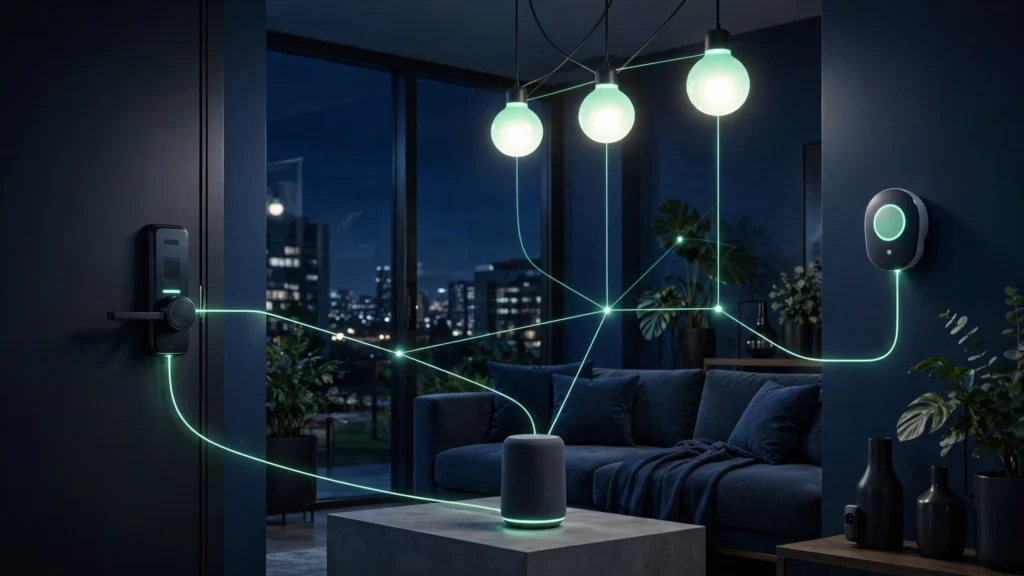
What Is Matter? The Smart Home Standard Explained (2026)
What is Matter? It is the question every smart home buyer ends up asking sooner or later — usually right after buying a smart bulb that refuses to talk to the voice assistant they already own. Matter is the open smart home standard that finally fixes that problem: a shared language that lets devices from different brands work together, no matter which ecosystem you use.
Built by the Connectivity Standards Alliance (CSA) — an industry group that includes Apple, Google, Amazon, and Samsung — Matter is not a new gadget or a new app. It is a set of rules that device makers agree to follow, tested in certified labs, so that a smart plug from one company works with the smart speaker of another. If you see the Matter logo on a box, that product is guaranteed to work with your smart home platform of choice.
In this guide, we explain what is Matter, how it works, what it runs on, which devices support it, and whether you should care about it before your next smart home purchase.
What Is Matter? The Short Answer
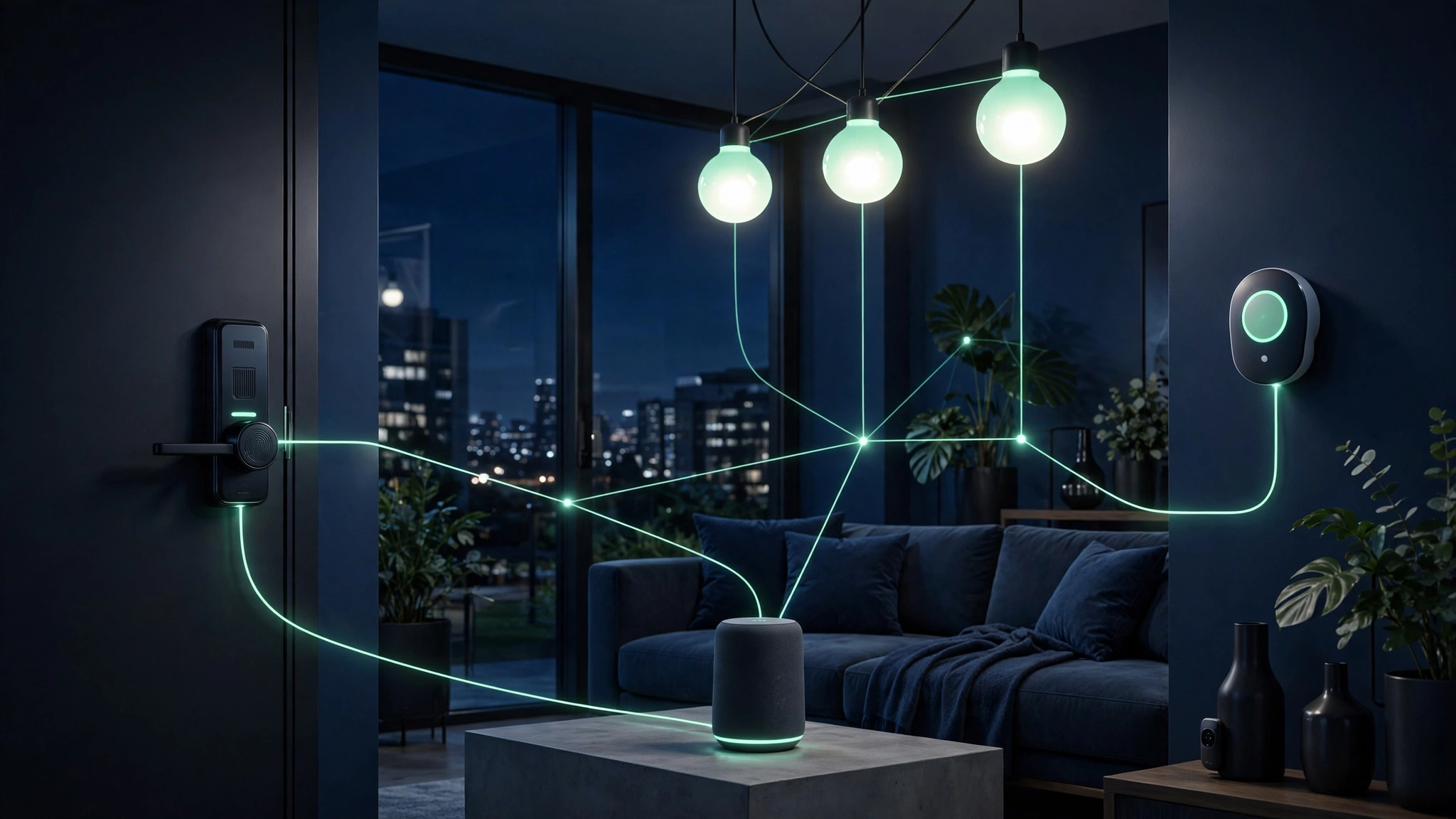
What is Matter, in one sentence? Matter is a universal, open-source smart home standard that lets devices from different manufacturers communicate with each other across Apple Home, Google Home, Amazon Alexa, and Samsung SmartThings.
Before Matter, the smart home was a mess of incompatible systems. A light bulb bought for Alexa might not work with Google Home. A smart lock might need its own hub, its own app, and its own account. Buying into one ecosystem meant being locked into it — and mixing brands meant juggling half a dozen apps to turn your lights off.
Matter replaces that fragmentation with a single standard. A Matter-certified device works with every major platform, because every major platform has agreed to support the same rules. That is the whole idea: buy the product you like, from the brand you like, and it works with the system you already have.
The standard launched as Matter 1.0 in late 2022, and it has been expanding ever since. Each new revision adds more device types and features, and by 2026 the standard covers almost every common smart home product — from bulbs and plugs to locks, thermostats, blinds, cameras, and more.
How Matter Works: Wi-Fi, Thread, and Bluetooth
One of the most common misunderstandings about Matter is that it is a wireless signal, like Wi-Fi or Bluetooth. It is not. What is Matter, technically, is an application layer — a shared language that travels over networks your home already has, mainly Wi-Fi, Thread, and wired Ethernet. Bluetooth Low Energy is used only to set a new device up, not to run it day to day.
Wi-Fi carries Matter for devices that need more bandwidth or constant power: smart speakers, displays, cameras, and appliances. Thread is the low-power mesh network for the small stuff: sensors, plugs, bulbs, and locks. Thread devices form a mesh, passing messages from one device to the next, so a sensor at the far end of the house can still reach your hub through its neighbours — and the mesh gets stronger as you add more devices.
That local design is one of Matter’s biggest advantages, and it answers a common follow-up to what is Matter: does it need the cloud? No. Because Matter devices talk to each other directly over your home network, they keep working even if your internet connection goes down. A cloud-dependent smart bulb stops responding when the broadband drops; a Matter bulb on Thread keeps turning on and off. Local control also means faster responses and better privacy, since commands do not have to travel to a distant server and back.
Every Matter setup needs a controller — sometimes called a Matter hub. That is usually a smart speaker, a display, or a phone app that manages onboarding and communication. Apple TV, HomePod, Google Nest Hub, Amazon Echo, and Samsung SmartThings hubs all act as Matter controllers, so there is a good chance you already own one.
Multi-Admin: One Device, Every Platform at Once
Matter’s standout feature is called multi-admin, and it is the one that makes the standard feel like magic — it is what is Matter’s killer feature for households that cannot agree on one voice assistant. A single Matter device can be linked to more than one platform or app at the same time — so the same smart lock can appear in Apple Home for you, Google Home for your partner, and Alexa for the kids, all without any extra hardware.
Before Matter, sharing a device across platforms was effectively impossible. You picked one ecosystem and lived with it. With multi-admin, the household stops arguing about which assistant to use, because every assistant can control the same devices.
Setting it up is simple: you add the device to your first platform by scanning its Matter QR code, then share it to a second platform from the first platform’s app. The device stays connected to both, and either platform can control it. If you ever switch ecosystems — say, from Alexa to Google Home — your Matter devices come with you, instead of becoming expensive paperweights.
Matter vs Zigbee vs Z-Wave: What’s the Difference?
If you have shopped for smart home gear before, you have probably seen Zigbee and Z-Wave on the box. Those are older wireless protocols that each built their own walled garden: Zigbee devices mostly worked with Zigbee hubs, Z-Wave devices with Z-Wave hubs, and neither talked to the other.
Matter is different in two ways, and understanding them is the clearest way to grasp what is Matter at a technical level. First, it is IP-based, built on the same internet protocols (IPv6) that the rest of your network already uses, rather than a proprietary radio system. Second, it is backed by all the major platforms at once — Apple, Google, Amazon, and Samsung all helped create it — so it is a standard everyone agreed on, rather than one company’s bet.
That does not make your old Zigbee gear useless. Many Zigbee devices can join a Matter setup through a bridge — a device that translates between the two protocols. Philips Hue, for example, lets its Zigbee bulbs work in a Matter home through the Hue Bridge. So if you already own Zigbee or Z-Wave devices, you can usually keep them and add Matter devices alongside, rather than starting over.
Which Devices Support Matter in 2026?
The Matter 1.0 specification launched with support for light bulbs, switches, smart plugs, smart locks, safety and security sensors, media devices, blinds and shades, HVAC controllers, thermostats, and garage door controllers. Since then, the standard has grown steadily, and the latest revision — Matter 1.5 — adds video camera support and soil sensors, while improving EV charging and window-covering features.
In practice, that means almost every common smart home category now has Matter-certified options. If you are asking what is Matter’s device coverage in 2026, the honest answer is: almost everything you would want to automate. Smart locks are a particular highlight: if you are shopping for one, our roundup of the best smart locks 2026 includes several Matter-ready models. Smart speakers are covered in our best smart speakers 2026 guide, and many of the top picks double as Matter controllers.
When you shop, look for the Matter logo on the packaging or the product page. That badge means the device passed testing at a CSA-approved lab and is certified to work with the standard. Be careful with wording: some products say “works with Matter” through a bridge or a future update, while others are natively Matter-certified. Native support is the safer bet, because it does not depend on another device or a promised firmware update.
Do You Need a Matter Hub?
To use Matter, you need a Matter controller, but you probably already have one. A common follow-up to what is Matter is whether it needs new hardware, and the good news is that any recent smart speaker or display from Apple, Google, or Amazon can act as a controller — a HomePod mini, a Nest Hub, an Echo, or a Samsung SmartThings hub all qualify. Many Wi-Fi routers and smart TVs are also starting to include Matter controller support.
What you do not need is a separate Matter hub for each brand. One controller can manage devices from every brand, because the whole point of the standard is that the controller and the devices speak the same language regardless of who made them.
Thread devices add one wrinkle: they need a Thread border router to connect the Thread mesh to your Wi-Fi network. Many modern speakers and displays include one — recent HomePods, Nest Hubs, and Echos all do — so in most homes the border router is already sitting on a shelf. If yours does not have one, a single Thread border router (often built into a smart speaker you were going to buy anyway) covers the whole house.
Should You Buy Matter Devices in 2026?
For most people, the answer is yes — with a small caveat. If you are buying a new smart home device in 2026, choosing a Matter-certified model is the safest long-term bet, because what is Matter’s core promise is simple: the device you buy today will work with whatever platform you use tomorrow. It protects you against ecosystem lock-in, it keeps working if your internet drops, and it will still work if you switch from Alexa to Google Home (or the other way) next year.
The caveat is that Matter is still maturing. Some advanced features — like the fancy extras in a manufacturer’s own app — may only be available in that app, not through Matter. A smart lock’s auto-unlock or a camera’s AI detection might need the brand’s own software. Matter guarantees the basics work everywhere; the extras may still live in one app.
That is a fair trade for most buyers, and it is getting better with every revision. Matter 1.5’s camera support, for example, is already pushing brands to bring their cameras into the standard, and each new device type that joins makes the ecosystem more complete.
If you are starting a smart home from scratch, our guide on how to set up a smart home in 2026 walks through the whole process step by step — and choosing Matter-certified gear from the start is the single best decision you can make in that process.
The Bottom Line on Matter
So, what is Matter? It is the smart home standard that ends the era of incompatible gadgets: an open, IP-based framework run by the Connectivity Standards Alliance, built on Wi-Fi and Thread, with local control, multi-admin sharing, and certification that guarantees devices from different brands actually work together.
It is not perfect — advanced features can still hide in brand apps, and older devices may need a bridge — but it is the closest the smart home has ever come to “it just works.” That, in the end, is what is Matter for: ending the compatibility guessing game every time you buy a gadget for your home. If you buy one thing this year for your home, make sure it has the Matter logo on the box. Your future self, switching voice assistants at 2 a.m. because the old one annoyed you, will be grateful.
For a deeper technical walkthrough of how Matter and Thread fit together, MakeUseOf’s explainer (makeuseof.com) covers the protocol details, the device types, and the state of support in 2026.
Conclusion
What is Matter? It is the answer to the smart home’s oldest problem — a universal standard that lets a bulb from one brand, a lock from another, and a speaker from a third all work together in the same home, on the same network, under any voice assistant you choose.
Matter runs over Wi-Fi and Thread, works locally when the internet fails, lets one device serve multiple platforms at once, and is backed by every major tech company. In 2026, with cameras and more device types joining the standard, there has never been a better time to build — or rebuild — your smart home around it. Look for the logo, pick the products you actually like, and stop worrying about whether they will talk to each other. They will.