
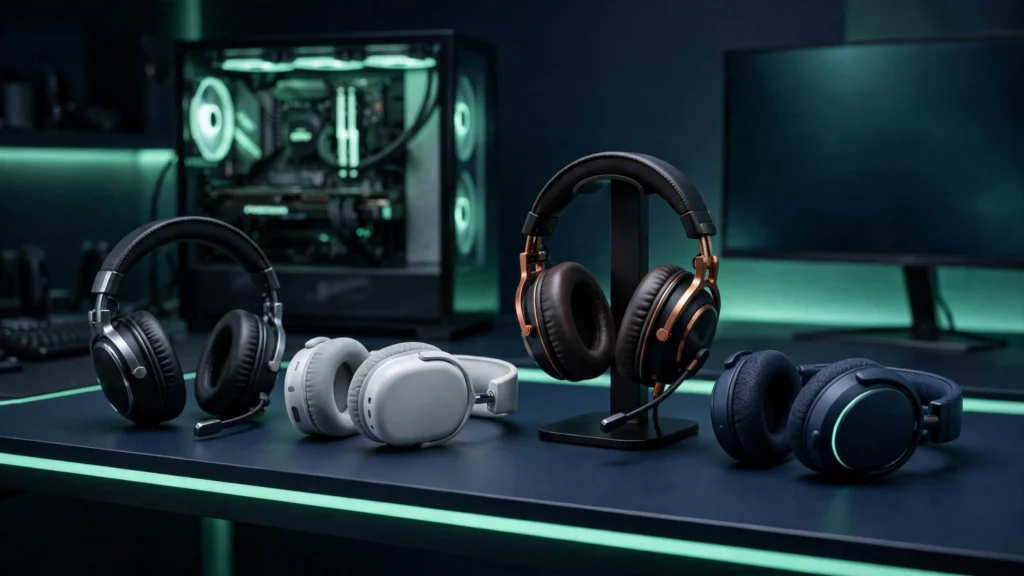
Best Gaming Headsets 2026: 7 Top Picks for Every Budget
A great gaming headset does more than play sound. It tells you where footsteps are coming from, keeps your voice clear when the team fight gets chaotic, and stays comfortable through a four-hour session. The best gaming headsets 2026 have all improved in the same three areas — wireless reliability, microphone quality, and long-session comfort — which makes this a genuinely good year to upgrade.
This guide ranks the best gaming headsets 2026 across budgets and platforms, explains what actually matters when you buy one, and helps you avoid the most common mistakes. Our picks are based on the features that consistently separate great headsets from mediocre ones in 2026: driver quality, wireless performance, mic clarity, comfort, build, and value for money.

How We Chose the Best Gaming Headsets 2026
We evaluated headsets on six criteria. Sound quality comes first: clear mids for dialogue and effects, controlled bass that adds impact without drowning out footsteps, and a wide soundstage for positional audio. Microphone quality is second — your teammates hear the mic, not the drivers, and 2026’s best headsets have closed much of the gap between headset mics and standalone microphones. Comfort is third: weight distribution, ear cushion material, and clamping force decide whether a headset disappears on your head or becomes a headache by hour two.
Wireless performance is fourth. In 2026, 2.4 GHz wireless connections are essentially latency-free for gaming, and battery life on flagship wireless models routinely exceeds 60 hours, with some pushing past 100. Bluetooth multipoint — staying connected to your phone and your game at once — is now a standard expectation rather than a premium extra. Build quality is fifth: metal reinforcement in the headband, replaceable ear cushions, and a detachable cable or mic all extend a headset’s life. Value is sixth: a $350 headset should be meaningfully better than a $150 one, and our budget picks prove you do not need to spend flagship money for great sound.
The 7 Best Gaming Headsets 2026
1. Best Overall: The Flagship Wireless All-Rounder
The best gaming headset of 2026 for most people is a flagship wireless model with 2.4 GHz and Bluetooth, a broadcast-quality detachable mic, and 70+ hours of battery life. These headsets pair planar or high-end dynamic drivers with tuned sound profiles for both competitive and cinematic games, and their comfort is engineered for all-day wear with lightweight frames and cooling ear cushions. Expect to pay in the $250–$350 range. If you play on PC and console and want one headset that does everything, start here.
2. Best for Competitive FPS: The Esports Pick
Competitive players should prioritize imaging and a neutral sound signature over bass. The best esports headsets of 2026 are typically lightweight wired or 2.4 GHz wireless models with studio-style tuning that makes footsteps, reloads, and ability cues easy to locate. Many top competitive players still prefer wired for absolute zero-latency confidence, and several 2026 esports models include tournament-ready features like a detachable mic and travel case. These usually land in the $150–$250 range and are the right choice if ranked ladders are your life.
3. Best Budget Pick: Great Sound Under $100
You do not need to spend $200 for good gaming audio. The best gaming headsets 2026 for under $100 deliver clear, balanced sound, a genuinely usable mic, and solid comfort — sometimes well under $100. What you give up is wireless convenience, premium materials, and the last 10% of sound refinement. What you keep is everything that matters for enjoying games and communicating clearly. For students, first setups, or anyone upgrading from earbuds, this category is the smartest money in gaming audio. Pair it with our guide on reducing ping and fixing lag and your whole setup gets a competitive edge for very little money.
4. Best for PS5: Console-Optimized Wireless
PlayStation 5 players get the most from headsets that support the console’s 3D audio properly and connect cleanly — either through the DualSense controller, USB dongle, or Sony’s own wireless ecosystem. The best gaming headsets 2026 for PS5 integrate with the console’s Tempest 3D audio for genuinely impressive spatial sound, and first-party and licensed options offer the smoothest experience with system-level controls. If you game mostly on PS5, prioritize a headset tested specifically with the console over a generic multi-platform model.
5. Best for Xbox: Seamless Console Wireless
Xbox players should look for headsets with direct Xbox Wireless protocol support, which pairs like a controller with no dongle required. The best gaming headsets 2026 for Xbox connect instantly, support Dolby Atmos and Windows Sonic spatial audio, and often work across Xbox consoles and PC. Licensed models from major brands dominate this category, and the convenience of dongle-free pairing is hard to give up once you have tried it.
6. Best Wired Audiophile Pick: For Sound Purists
Some players want the best possible sound and do not care about wireless. The best gaming headsets 2026 for sound purists use open-back or high-end closed-back designs with large drivers, delivering a soundstage and detail that wireless models still cannot quite match. You will usually pair these with a separate DAC/amp or a good motherboard audio setup, and add a standalone mic or a clip-on boom for voice. This is the enthusiast route: more effort, more cables, and the best raw audio quality money can buy under $300.
7. Best for Comfort: The All-Day Marathon Headset
If you wear a headset for work calls and then for gaming, comfort is the whole game. The best gaming headsets 2026 for all-day comfort weigh under 300 grams, use suspension-style headbands that distribute weight, and have breathable ear cushions that do not trap heat. Several models now include hot-swappable batteries so a marathon session never ends for a charging cable. Glasses wearers should pay special attention here: low clamping force and soft, deep cushions make the difference between forgetting the headset and counting the minutes.
Wired vs Wireless in 2026: What Should You Choose?
In 2026, this debate is mostly settled for gaming: modern 2.4 GHz wireless is as fast as wired for all practical purposes, with latency well below what any human can perceive. Choose wireless if you value freedom of movement, a clean desk, and multipoint connections to your phone. Choose wired if you want the lowest possible price, never want to think about charging, or are chasing audiophile-grade sound.
Battery life is no longer a real concern on good wireless models — 60 to 100+ hours means charging every few weeks, not every night. The remaining wireless trade-offs are price (wireless costs more at the same quality level) and a small weight penalty for the battery. If your budget is tight, a $100 wired headset will sound better than a $100 wireless one. At $200 and above, wireless catches up and the convenience wins.
What to Look For: Gaming Headset Buying Checklist
Start with platform compatibility. A headset that is perfect on PC may lack features on PlayStation or Xbox, so check for your console specifically. Next, decide wired vs wireless based on your budget and desk setup. Then prioritize comfort: read reviews from people with your head size and glasses situation, because comfort is personal and specs do not capture it. Check the mic with sample recordings if you can — a great-sounding headset with a bad mic is a bad gaming headset.
Look for spatial audio support (Tempest 3D on PS5, Dolby Atmos or Windows Sonic on Xbox/PC) if you play competitive shooters, and check whether it is included or a paid add-on. Verify the connection options: 2.4 GHz dongle for gaming, Bluetooth for phone calls, and ideally both at once. Finally, check the little things that determine longevity — detachable cables, replaceable ear cushions, a folding or detachable mic, and a warranty from a brand with real support. A headset is a multi-year purchase; buy one that can be repaired, not replaced.
Common Gaming Headset Mistakes to Avoid
The biggest mistake is buying for bass. Huge bass sounds exciting in a store demo but masks footsteps and dialogue in real games — the exact sounds competitive players need most. Second, do not confuse “7.1 surround” marketing with real spatial audio; modern games and consoles do positional audio better through stereo drivers plus proper spatial processing. Third, do not buy a headset for a platform it was not designed for and expect every feature to work. Fourth, do not ignore weight: a 400-gram headset feels fine for twenty minutes and terrible for three hours.
Finally, do not forget your setup around the headset. A great headset on a noisy connection still loses to lag — see our guide to reducing ping — and a great headset deserves a good display to match, like the picks in our best gaming monitors of 2026 and our best mechanical keyboards roundup for the full battlestation upgrade.
The Bottom Line
The best gaming headset of 2026 for most players is a flagship wireless all-rounder in the $250–$350 range: 2.4 GHz plus Bluetooth, a genuinely good mic, 70+ hours of battery, and comfort you forget you are wearing. Competitive players should go lighter and more neutral, budget buyers can get 80% of the experience under $100, and console loyalists should buy for their platform specifically. Whatever you choose, prioritize comfort and mic quality over marketing specs — those are the two things you will notice every single day you play.